

A teller copies a member's
email, including name, account type and branch location, and pastes it into
ChatGPT asking it to "write a professional response to this email."
While benchmarking risk
controls, your risk management specialist pastes a portion of your risk
assessment matrix into Claude with the prompt: "Can you rewrite these
control descriptions more clearly and suggest any gaps?"
Your branch manager, after a
busy morning and on deadline to submit quarterly team performance reviews and
plans by 5 pm, asks ChatGPT: "Turn these performance notes into a clear
coaching plan for my employee."
It's happening in the simple
daily rhythms of your branch — responding to member inquiries or concerns;
taking a shortcut when the next meeting starts in five minutes; and when
showing up as prepared and knowledgeable as possible will help land that next
member.
On the surface, these are the
moments that happen on an ordinary Tuesday. In reality, these are compliance
risks hidden in plain sight.
Let's take a closer look:
In the first example, the
teller left your secure IT system and pasted protected member information into
a public AI model.
In the second, the very
framework you'd present to an examiner, is now training data for an unvetted
third-party tool.
In the third scenario, an
employee's HR information (performance concerns, coaching needs) now sits on
servers you don't control and can't retrieve.
Your team isn't careless.
They're using a tool that is so accessible and convenient, that reaching for it
doesn't feel like a choice — especially when the to-do list is longer than the
hours in the day.
And let's face it, you're
running lean. Even your day includes wearing hats far outside the
"executive" lane - managing vendor relationships, writing job
descriptions, fixing a printer, explaining policy decisions, troubleshooting
Wi-Fi and even covering for vacations.
You're not alone. According to Wipfli's
2026 State of the Credit Union Industry Report, 67% of institutions are
implementing AI, but only 16% have an enterprise-wide roadmap. Essentially, the
tools are in use. The governance isn't.
The question isn't whether you
formally adopt AI — it's already embedded in how your team works. The question
is whether you can demonstrate how you're managing the associated risks.
The National Credit Union
Administration (NCUA) has prioritized three main areas that intersect with AI:
Operational risk management - this includes oversight
of critical operational domains that directly affect financial stability and
member trust.
Third-party vendor oversight - especially important
since tools you use, such as core processors, your loan origination system, and
the chatbot on your website all are AI-powered.
Fraud prevention and detection - fraud within the
U.S. financial systems remains a threat, making your internal controls and
efforts to deter and detect fraud that much more critical.
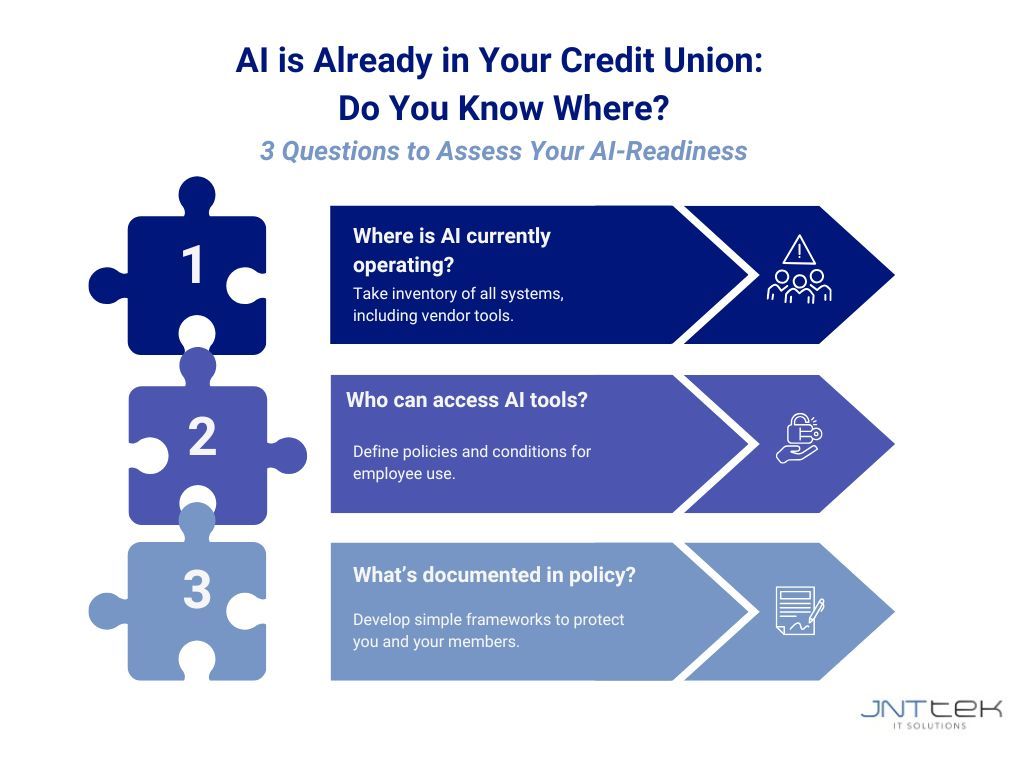
Here are three main questions
to consider as you assess your credit union's AI-readiness:
- Where is AI currently operating? Given the examples above, it's being used already, so take an inventory of all your systems, including those with vendors, to understand where AI is powering decisions or processing information.
- Who can access AI tools? Do you have a policy in place? Under what conditions are employees using tools and how?
- What's documented in policy? Are your systems and processes documented in policies? If asked, could you point to where those are? The point isn't necessarily to overly complicate things, but to have simple frameworks and policies that protect you and your members.
What does a good governance
structure look like for your organization? It's not as complicated as it
sounds, but it requires being diligent and intentional.
Have a written policy on how AI
can and should be used. Be sure it outlines who is accountable and who owns the
decisions surrounding AI. Regularly review AI use with your vendors to
understand the safeguards they currently have in place. AI is rapidly evolving
so the goal isn't perfection; it's having awareness, clarity and reasonable
controls to reduce risk.
Your team will keep reaching
for tools to help them serve your members. Rather than stop anyone from using
them, make sure guardrails are in place before you are asked by an examiner to
show them. And if you aren't sure where to start, JNTtek helps credit unions
just like yours to assess readiness and build practical frameworks specific to
your reality and risk profile.


