
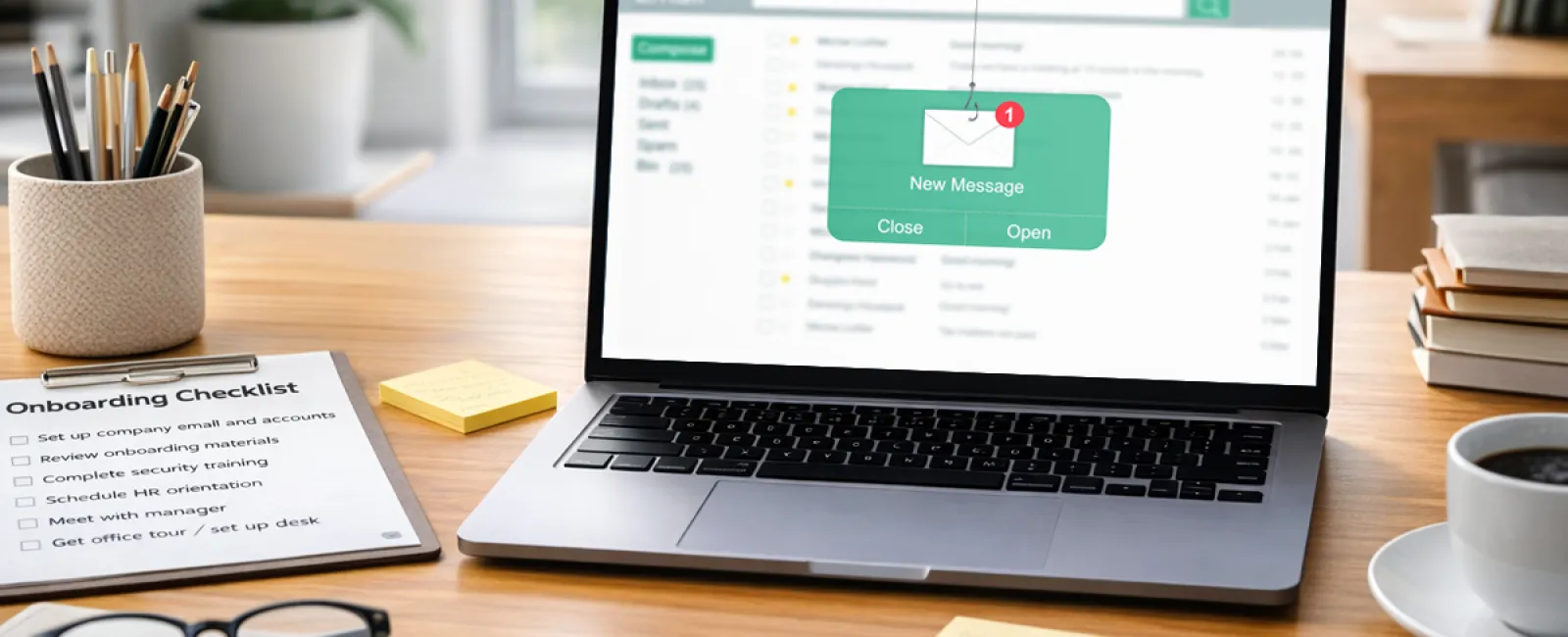
An email lands on a Tuesday morning, and at first glance, nothing seems unusual.
It appears to be from the CEO. The name checks out. The wording feels authentic. Even the signature looks convincing.
"Hey — can you help me with something quickly? I'm in back-to-back meetings. Need you to handle a vendor payment. I'll explain later."
The new hire hesitates.
They've only been on the job for four days. They're still learning the flow, still figuring out who does what, and they do not want to be the person who challenges the CEO in week one.
So they do what seems reasonable and step in to help.
By then, the harm is already underway.
Why the first week is the riskiest
Each spring, companies welcome a fresh round of employees, often recent graduates and summer interns starting their first professional roles. For the business, it is onboarding season. For attackers, it is open season.
Keepnet Lab's 2025 New Hires Phishing Susceptibility Report found that CEO impersonation emails are 45% more likely to succeed with new hires than with experienced staff.
Cybercriminals do not usually target your most experienced people first. They focus on the employees still learning the basics, because the early days are full of uncertainty and unfamiliar routines.
A new employee may not know what a normal request looks like. They may not understand how the CEO typically communicates. They have not yet built the instincts or confidence that come with time, and attackers know how to exploit that gap.
But the real issue is not the new employee. The biggest risk is not the person who is careless. It is the person who is trying to be useful.
If you manage a team, you probably already know exactly who would answer that email first.
The problem is not just training. It is the setup.
Think back to day one.
The laptop was not ready. Access was incomplete. The email account was still being built. They used someone else's login to check one thing quickly. They saved a file to the desktop because the shared drive was not available. They pulled up a client number on their personal phone because it was faster.
None of that felt unsafe. It felt practical. It felt like the fastest way to keep moving on a hectic first day.
But during that first week, before everything is fully in place, several security gaps open quietly. Shared credentials create untracked accounts, files fall outside backup coverage, personal devices touch company data, and no one clearly explains what to do when something seems suspicious.
The same Keepnet report found that new employees are 44% more likely to fall for phishing than tenured staff. That gap is not about negligence. It is about disorder. When onboarding is messy, security becomes an afterthought. That is exactly the environment a phishing email is designed to exploit.
The attack did not create the weakness. The first day did.
What a secure first day should include
Solving this does not require a long security lecture on day one. It requires three things to be ready before the new hire arrives.
1. Access is prepared, not improvised.
The laptop should be ready, credentials should already exist, and permissions should be clearly assigned. No shared logins, no temporary fixes, and no "we'll handle that later this week."
2. They understand what a normal request looks like.
A brief 10-minute orientation can go a long way. Does the CEO ever send payment requests? Who approves financial changes? What should they do if something seems unusual? This is not formal security training; it is practical guidance.
3. They have a safe place to ask questions.
The person who paused before clicking that email might have checked first if they knew who to ask. Most first-week mistakes stay hidden because new hires do not want to seem unsure.
Give them a person. Give them a clear process.
Most security failures do not happen because someone breaks the rules. They happen because no one explained the rules yet.
Maybe your onboarding is already strong. Maybe your team is small enough that the first few days feel personal instead of procedural. But if a new hire has ever had to improvise through week one — or if you are planning to bring someone on this spring — it is worth fixing the gaps before that Tuesday email shows up.
Click here or give us a call at 323-410-7785 to schedule your free 10-Minute Discovery Call.
And if you know another business owner who is hiring soon, share this with them. The smartest time to secure the door is before someone tries to walk through it.


